
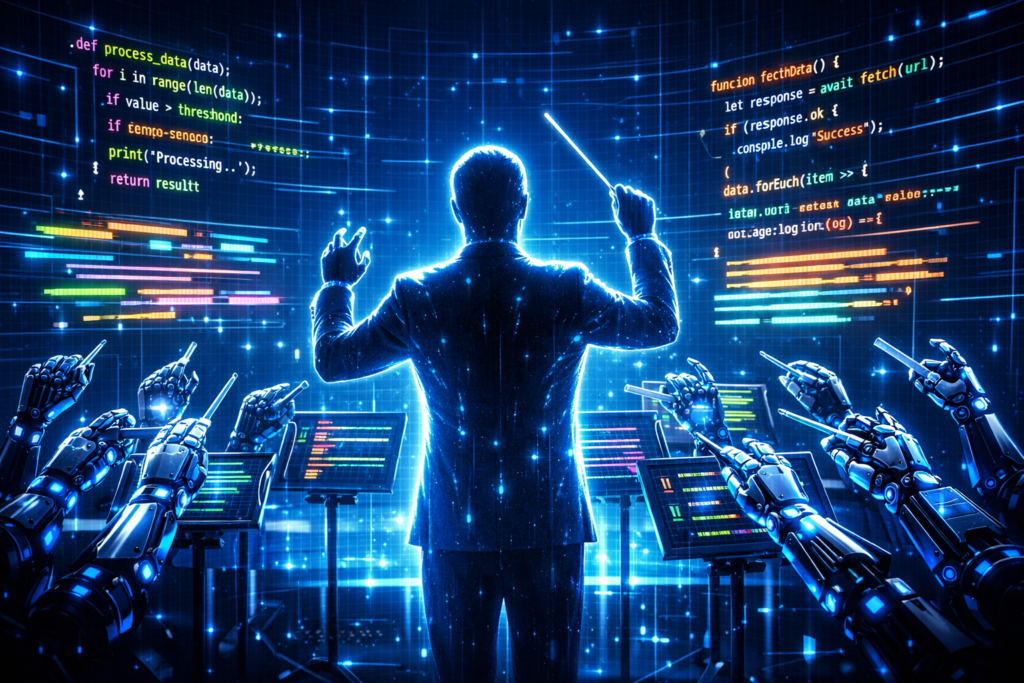
Keyword: Vibe Coding, Developer as Orchestrator, AI-assisted development, AI coding tools, software development trends
The way we build software is changing—and it’s changing fast. Gone are the days when every line of code had to be typed out manually, with developers spending hours debugging syntax errors. Welcome to the era of Vibe Coding, a term that’s taking the tech world by storm.
But what does this mean for the future of programming? Does it spell the end for traditional developers? Or is it simply shifting their role into something more powerful? In this post, we’ll break down what Vibe Coding is, how it works, and why the most successful tech professionals are evolving from “Coders” into “Orchestrators.”
What is Vibe Coding? (A Simple Definition)
Vibe Coding is a new approach to software development where you use artificial intelligence (AI) to generate code. Instead of writing code line-by-line, you simply describe what you want in plain, natural language .
The term was coined by Andrej Karpathy, a renowned computer scientist and former researcher at OpenAI. He described it as fully “giving in to the vibes,” where you forget that the code even exists and just guide the AI to create what you need .
Think of it like this:
- Traditional Coding: You are a craftsman building a chair from scratch, cutting every piece of wood yourself.
- Vibe Coding: You are a director telling a skilled robot, “Build a comfortable wooden chair with four legs,” and the robot handles the cutting and assembly.
You focus on the vision, and the AI handles the execution.
How Does It Work in Practice?
A “Vibe Coder” might use tools that integrate with their code editor. They might type a comment like, “Create a blue button that fades in when the page loads,” or even speak it into a microphone. The AI then writes the JavaScript and CSS code to make that button work . If there’s a bug, the developer pastes the error message back to the AI and lets it figure out the fix .
The Developer is Dead, Long Live the Orchestrator
This shift brings us to the most important concept for modern developers: The Developer as Orchestrator.
In a Vibe Coding world, your value isn’t in typing syntax—AI is better at that now. Your true value lies in your ability to orchestrate. This means moving up the ladder from a “Level 1 Prompter” to a “Level 5 Orchestrator” .
An Orchestrator doesn’t just ask the AI for one snippet of code. They build systems where multiple specialized AI agents work together as a team .
Imagine an AI-powered development team that you conduct:
- The Product Manager Agent: You tell it your high-level idea.
- The Developer Agent: It writes the actual code based on the plan.
- The QA Tester Agent: It reviews the code and finds bugs .
Your job becomes that of a conductor—setting the vision, choosing the right tools, and ensuring the final output is harmonious and secure. This requires system design thinking, security oversight, and a clear product vision .
Why This Matters: The Benefits of Vibe Coding
This isn’t just a fun trend; it’s a fundamental shift in productivity.
1. Lightning-Fast Prototyping
What used to take a week can now take a few hours. Developers are building and launching full games and tools in record time. For example, one developer, Levelsio, built a 3D flight game called Fly Pieter in just three hours using Vibe Coding tools. It went on to earn thousands of dollars in its first week .
2. Democratizing Development
You don’t need a computer science degree to build software anymore. A teacher can create an interactive learning app, or a salesperson can prototype a customer dashboard without writing a single line of code manually . This opens up innovation to everyone.
3. Focusing on What Matters
By offloading the grunt work to AI, developers can focus on high-level architecture, user experience, and solving complex business problems. It reduces cognitive load and helps you stay in a creative “flow state” .
The Reality Check: Limitations and Risks
Before you fire your entire engineering team, it’s crucial to understand the risks. Vibe Coding isn’t magic—it still needs a human pilot.
1. Security Vulnerabilities
AI-generated code can have serious security flaws. If you don’t understand security best practices, you might ship an app that is easy to hack. One non-technical user who built an app with Vibe Coding famously posted, “Guys, I’m getting attacked,” after hackers found his security gaps .
2. Technical Debt and Messy Code
AI can write code that works but is poorly structured. This “spaghetti code” is hard to maintain, update, or scale later. Without an experienced developer to clean it up, the project becomes fragile .
3. The “Hallucination” Problem
AI models can still generate incorrect or nonsensical code. They don’t truly understand the logic; they just predict the next word. Human oversight is non-negotiable to catch these errors .
The Orchestrator’s Toolkit: Essential Tools for 2025
To succeed as an Orchestrator, you need the right instruments. Here are some of the top tools enabling Vibe Coding and agentic workflows :
Conclusion: Embrace the Shift
Vibe Coding is not about making developers obsolete; it’s about elevating them. The demand for “Senior Vibe Coding Developers” is already appearing in job listings, with companies looking for people who know when to trust the AI and when to step in and take control .
The future belongs to the Orchestrators—those who can combine the raw power of AI with human judgment, security awareness, and creative vision.
Are you ready to stop just writing code and start conducting the symphony?
What are your thoughts on Vibe Coding? Are you using AI tools in your workflow? Let us know in the comments below!