
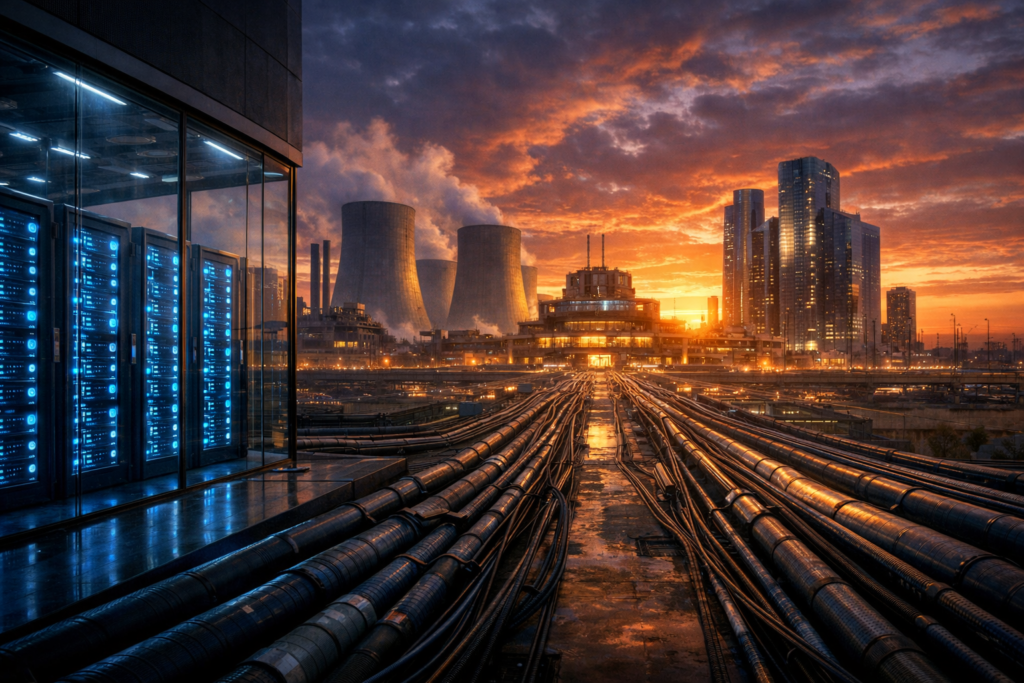
The race for artificial intelligence supremacy has fundamentally changed. If 2023 and 2024 were about flashy chatbots and model announcements, 2026 is about something far less glamorous but far more critical: infrastructure. We are witnessing the birth of a new industrial revolution, where the winners won’t be determined by who has the smartest algorithm, but by who can build the biggest barns to house the smartest brains.
Think of AI not just as software, but as a new kind of factory. This factory needs land (data centers), machines (specialized computer chips), and a massive amount of power to run it all. The companies and countries that can build this new industrial backbone the fastest and most efficiently are the ones pulling ahead in the new AI infrastructure race .
Here is your complete guide to understanding this crucial shift in simple, straightforward English.
1. It’s a Spending Race Like No Other
The first and most obvious sign of this new race is the sheer amount of money being thrown at it. We are talking about numbers that were unimaginable just a few years ago.
In 2026, the world’s top eight cloud service providers—the companies that rent out computing power—are projected to spend a combined $710 billion on AI infrastructure . To put that in perspective, that’s more than the GDP of many countries. This spending isn’t on marketing or research papers; it’s on concrete, physical assets.
- Amazon is leading the pack with a planned $200 billion in capital investments .
- Alphabet (Google) is close behind, with spending estimated between $175 billion and $185 billion . Google is unique because it’s relying heavily on its own in-house chips (TPUs) rather than buying all its chips from companies like Nvidia .
- Meta is also making a huge bet, with its spending set to exceed $124.5 billion .
This isn’t just corporate spending; it’s national strategy. The United States has launched the “US AI Action Plan,” a policy shift that treats AI computing power as a critical national resource, like oil or nuclear energy . This plan uses tariffs and trade deals to encourage chip manufacturing on American soil.
One of the most ambitious examples of this public-private partnership is “Project Stargate.” This is a $500 billion joint venture between OpenAI, Oracle, and SoftBank to build a massive network of AI data centers across the U.S., starting in Texas . This isn’t just building a bigger server farm; it’s about creating the industrial-age factories for the digital age.
2. The New Gold: Energy and Chips
All this spending is flowing into two main areas: power and processing. Microsoft CEO Satya Nadella recently stated that energy costs will be the deciding factor in which countries win the AI race . He points to a new global commodity: “tokens,” the basic units of processing that AI models use. If you can produce these tokens more cheaply—primarily through cheaper energy—you have a massive economic advantage .
This is why you’re hearing so much about data centers and power grids.
- The Power Problem: AI data centers consume enormous amounts of electricity. Local power grids were never designed to handle this kind of demand. The solution? Companies are being pushed to build their own power sources, including natural gas plants and even Small Modular Nuclear Reactors (SMRs), right next to their data centers .
- The Chip Challenge: The brains of AI are GPUs (Graphics Processing Units) and specialized chips. The demand is so high that there are global shortages. This has led to two trends:
- Custom Chips (ASICs): Companies like Google, Amazon, and Microsoft are designing their own custom chips (like Google’s TPU or Amazon’s Trainium) to be more efficient and less dependent on a single supplier like Nvidia .
- Supply Chain Squeeze: The parts needed to build AI servers, from simple memory (DRAM) to complex processors, are facing huge price increases and long lead times .
3. Building the Smarter Factory
Building an AI data center isn’t like building a regular warehouse. The technology inside is changing fast to handle the immense power and heat generated by these new chips.
- From Air to Liquid: The latest, most powerful GPUs get too hot for traditional air conditioning. This means new “greenfield” data centers are being built with plumbing for liquid cooling—literally running pipes filled with special cooling fluids directly to the servers to carry the heat away .
- Speed is Everything: Inside the data center, chips need to talk to each other at incredible speeds. This is driving demand for high-speed optical cables (like 800G and soon 1.6T modules) to connect everything .
- Inference at the Edge: Not all AI needs to happen in a giant, centralized factory. Sometimes, you need an AI to act instantly, like in a self-driving car or a smart factory robot. This is leading to a trend called “edge AI,” where smaller, more efficient AI models run on local devices, reducing delays (latency) and saving money .
4. The Geopolitics of “Sovereign AI”
This infrastructure race isn’t just happening in the United States. Countries around the world are realizing that if they don’t build their own AI infrastructure, they will be forever dependent on the US and China. This has given rise to the concept of “Sovereign AI” .
Nations want to control their own data and have AI models that understand their local languages and cultures. This means building data centers within their own borders, which comes with its own set of challenges.
- Europe’s Challenge: European countries have high energy costs and complex regulations, which makes building competitive AI infrastructure more difficult. Microsoft’s Nadella has urged Europe to focus on global competitiveness rather than just local protectionism .
- New Players: We are seeing the rise of “neocloud” providers—companies outside the US tech giants that are building AI infrastructure for specific regions. For example, the European company Nscale recently raised over a billion dollars to build AI data centers across Europe, backed by major tech names . This shows a huge appetite for infrastructure that meets local regulatory and data privacy requirements .
5. From Hype to Reality: Is It a Bubble?
With all this money on the table, a big question looms: is this a sustainable industrial revolution or just another bubble?
There are real concerns. While tech giants are spending hundreds of billions, the actual revenue generated by AI applications isn’t yet keeping pace. This leads to worries about whether the massive investments will ever pay off .
However, a closer look shows that the money is starting to flow where it matters. In early 2026, AI startups raised around $12 billion, but investors are no longer throwing money at any company with “AI” in its name. They are prioritizing startups focused on infrastructure, governance, and practical tools that help businesses actually use AI .
Companies are also moving beyond simple experiments. In sectors like pharmaceuticals, companies like Pfizer are using AI to speed up drug discovery. In agriculture, AI is being used to optimize farming and improve crop yields. In energy, it’s helping to improve recycling processes . This shift from flashy demos to real-world, production-grade applications is the clearest sign that AI is becoming a true industrial backbone .
Conclusion: The Second Act Has Begun
The AI revolution has entered its second act. The first act was about invention—creating the powerful AI models that amazed the world. The second act, the one we are living through now, is about industrialization .
It’s a story of massive capital, scarce resources, and intense global competition. The winners will be those who can navigate the complex web of chip supply chains, energy grids, and national regulations. For the rest of us, the outcome of this race will determine how we work, live, and interact with technology for decades to come. The future of AI is no longer just in the code; it’s in the concrete, the copper, and the coolant of the new AI factories rising across the globe.