
- 3D Render Prompts
- AI Art Prompts
- Artificial Intelligence
- Cinematic Prompts
- Cyberpunk Prompts
- Hyper Realistic Prompts
- Programming
- Prompt Hub
- Realistic Photo Prompts
- Wallpaper Prompts
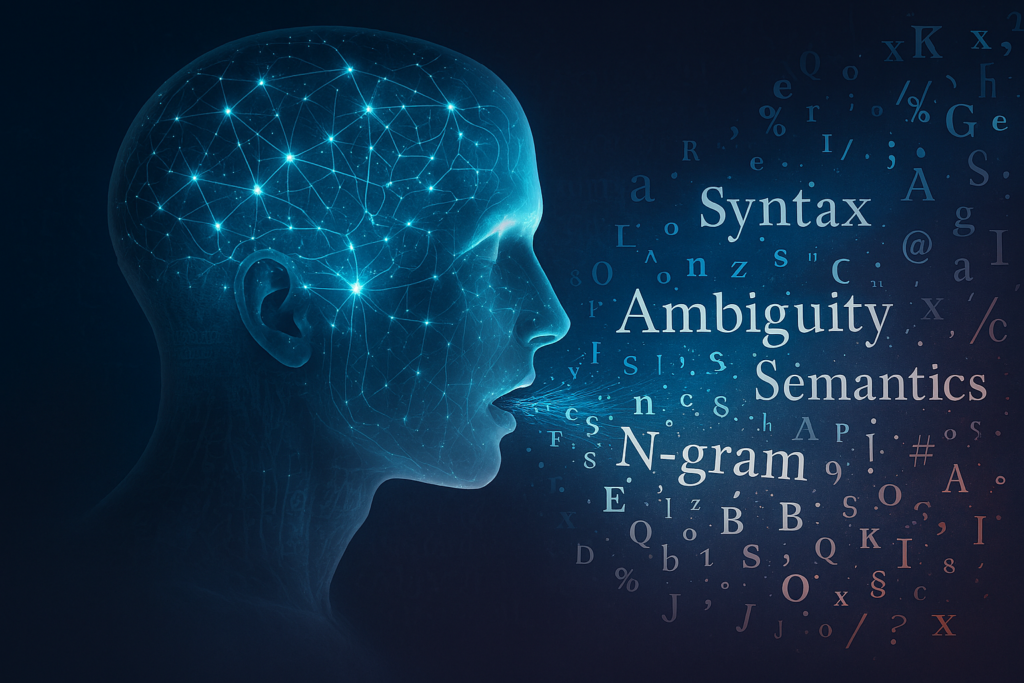
Imagine teaching a machine to understand not just numbers and code, but the subtle, poetic, and often confusing nature of human language. You want it to grasp that “I’m feeling under the weather” has nothing to do with meteorology or that the word “bank” can mean a financial institution or a riverside. This is the grand challenge of Natural Language Processing (NLP)—a fascinating field at the intersection of computer science, artificial intelligence, and linguistics.
As we communicate through emails, voice assistants, and global content, the ability for machines to process our language has moved from a novelty to a necessity. Whether it’s ChatGPT generating human-like text, your spam filter blocking unwanted emails, or a translation app helping you navigate a foreign city, NLP is the invisible engine powering these interactions. In this comprehensive guide, we will peel back the layers of this technology, starting from the fundamental building blocks of language to the sophisticated neural networks that drive today’s most advanced AI. Each concept is explained with multiple real-world examples to ensure you truly understand how machines decode our words.
1. Introduction to NLP
NLP – Definition and Introduction
Natural Language Processing (NLP) is a specialized branch of artificial intelligence that gives computers the ability to read, understand, interpret, and generate human language. Unlike programming languages like Python or Java, which are precise and structured, human language is messy, ambiguous, and constantly evolving. NLP bridges this gap by combining computational linguistics—rule-based modeling of human language—with statistical and deep learning models. These models enable machines to process text or voice data and grasp its full meaning, including the speaker’s intent and sentiment.
Example 1: Email Auto-Completion
When you compose an email in Gmail and see suggested words or phrases appearing as you type, that is NLP in action. The system analyzes the context of your sentence and predicts what you are likely to write next. If you type “I look forward to hearing,” the model might suggest “from you” because it has learned from millions of emails that this phrase commonly follows.
Example 2: Voice-Activated GPS
When you tell your car’s GPS system “Take me to the nearest coffee shop,” NLP converts your speech to text, identifies the intent (finding a location), extracts the entity (coffee shop), and executes the action. It ignores background noise, understands different accents, and still delivers the correct result.
Applications of NLP
You interact with NLP more often than you might realize. Its applications are woven into the fabric of our digital experiences:
- Machine Translation: Tools like Google Translate that convert text from one language to another.
Example: A traveler in Tokyo takes a photo of a Japanese menu. Google Lens extracts the text “焼き鳥” and translates it to “Grilled Chicken Skewers” in English, allowing them to order confidently.
- Sentiment Analysis: Businesses use this to determine if social media comments about their brand are positive, negative, or neutral.
Example: A smartphone company launches a new model. Using NLP, they scan thousands of tweets. A tweet saying “The battery life on the new XPhone is absolutely incredible!” is tagged as positive. Another saying “I’m so disappointed with the camera quality” is tagged as negative. This helps the company understand public perception instantly.
- Chatbots and Virtual Assistants: Siri, Alexa, and customer service bots that understand and respond to your queries.
Example: You visit an online clothing store at 2 AM and have a question about returns. A chatbot window opens, and you type “Do you have a return policy for shoes?” The bot understands the query, searches its knowledge base, and replies, “Yes, shoes can be returned within 30 days of purchase in their original condition.”
- Text Generation: Tools like Jasper or ChatGPT that can write essays, emails, or code.
Example: A marketing manager needs 10 catchy headlines for a new product. They prompt an AI tool with “Write 10 creative headlines for a eco-friendly water bottle.” Within seconds, the tool generates options like “Hydrate the Planet, One Bottle at a Time” and “Quench Your Thirst, Not the Earth’s Resources.”
- Information Extraction: Systems that scan legal documents or medical records to pull out key pieces of data.
Example: A law firm has thousands of contracts. An NLP system scans them all and automatically extracts key dates, parties involved, and renewal clauses, saving hundreds of hours of manual review.
Phases of NLP
To make sense of text, NLP systems typically go through a series of steps, moving from raw data to deep understanding:
- Lexical Analysis: This is the first step, involving breaking down the text into paragraphs, sentences, and words (tokens).Example: Consider the sentence: “Dr. Smith visited New York, and he loved it!” Lexical analysis breaks this into tokens: [“Dr.”, “Smith”, “visited”, “New”, “York”, “,”, “and”, “he”, “loved”, “it”, “!”]. Notice it correctly keeps “Dr.” as a single token despite the period, and splits punctuation.
- Syntactic Analysis (Parsing): Here, the system checks if the sentence follows the grammatical rules. It looks at the arrangement of words to understand the structure, such as identifying the subject and object in a sentence.Example: For the sentence “The dog chased the cat,” syntactic analysis identifies:
- Subject: “The dog”
- Verb: “chased”
- Object: “the cat”
This structure tells the machine who performed the action and who received it.
- Semantic Analysis: Semantic analysis is the phase of Natural Language Processing that focuses on understanding the literal meaning of words and sentences by mapping syntactic structures to actual objects, actions, and relationships in a given context. To understand this properly, let me explain what happens when a computer processes a simple sentence like “The pen is on the table.” First, the system performs word sense disambiguation to determine which meaning of “pen” is being used, because the word “pen” can refer to a writing instrument, an animal enclosure like a sheep pen, or even the act of writing itself. In this sentence, with words like “table” and the preposition “on” indicating location, semantic analysis correctly concludes that “pen” means a writing instrument and not a sheep enclosure, because sheep don’t typically sit on tables. Similarly, it determines that “table” refers to a piece of furniture with a flat surface rather than a mathematical chart or a verb meaning to postpone something.
Next, the system maps the relationship between these objects by understanding that the preposition “on” indicates a spatial relationship where one object rests atop another’s surface. The computer creates a mental model that represents the pen as an object of a certain size and type, the table as a location with a flat horizontal surface, and the relationship between them as one of resting or placement. This involves integrating world knowledge and common sense, such as understanding that tables typically have flat surfaces capable of supporting objects, that pens are small enough to fit on tables, and that gravity keeps the pen in place rather than floating. The computer essentially builds a small internal representation that says there exists a writing instrument called a pen, and its current position is on top of a furniture piece called a table. To make this even clearer, consider how semantic analysis handles the same word in different contexts. Take the sentence “The bat flew out of the cave.” Here, semantic analysis looks at the word “bat” which can mean a flying animal or a sports equipment, but because it sees the verb “flew” which implies flying action, and “cave” which is a natural shelter where animals live, it correctly identifies that this bat is the flying mammal.
Now contrast this with “The bat is lying on the cricket field.” In this case, the presence of “cricket field” which is a sports location, and the phrase “lying on” which describes an object placed horizontally, tells the system that this bat is the cricket bat used in sports. This is the essence of semantic analysis using surrounding context to determine the correct meaning and relationships between words. Semantic analysis also handles more complex situations like metaphors and idioms, though these push the boundaries of literal meaning.
When someone says “It’s raining cats and dogs,” semantic analysis must recognize that this is an idiomatic expression meaning heavy rainfall, rather than literally interpreting that animals are falling from the sky. Similarly, when a sentence has structural ambiguity like “The chicken is ready to eat,” semantic analysis must use real-world knowledge to determine whether the chicken is about to be fed or about to be cooked and eaten. Without semantic analysis, computers would just see words as meaningless tokens, but with it, they can build actual understanding of the situations and relationships being described, which is crucial for applications like translation, search engines, and question answering systems where knowing the correct meaning makes all the difference between a correct response and a completely wrong one. - Discourse Integration: Sentences rarely exist in isolation. This phase interprets the meaning of a sentence based on the ones that came before it.Example: Read these two sentences:
- “The dog chased the ball. It was fast.”
Discourse integration determines what “It” refers to. Based on context, it likely refers to “the dog” (the animal was fast) rather than “the ball,” though further analysis might be needed. If the next sentence was “It bounced down the street,” then “It” would refer to the ball.
- “The dog chased the ball. It was fast.”
- Pragmatic Analysis: The deepest level of analysis, this interprets the language based on the real-world context and intent, often detecting sarcasm or implied meanings.Example: Imagine a rainy day. Someone looks out the window and says, “What beautiful weather we’re having!” Pragmatic analysis understands that the literal meaning (the weather is beautiful) contradicts the reality (it is raining). Therefore, it concludes the speaker is being sarcastic and actually means the weather is unpleasant.
Difficulties in NLP: Ambiguity
The single biggest hurdle in NLP is ambiguity(confusion because of multiple meanings.). Human language is inherently ambiguous at multiple levels.
1. Pragmatic Ambiguity: The intended meaning depends heavily on context.
Example 1: If someone says “It’s cold in here,” they might simply be stating a fact, or they might be subtly asking you to close the window. The response depends on understanding the unspoken request.
Example 2: A teenager tells their parent, “I’m going out tonight.” The parent replies, “You have a big exam tomorrow.” The parent is not just stating a fact about the calendar; they are implying that the teenager should stay home and study.
2. Lexical Ambiguity: A word has multiple meanings.
Example 1: “The bat flew out of the cave.” vs. “He swung the bat and hit a home run.” The word “bat” means a flying animal in the first sentence and a sports equipment in the second.
Example 2: “I need to deposit this check at the bank.” vs. “The river overflowed its bank.” Here, “bank” refers to a financial institution in the first and the side of a river in the second.
3. Syntactic Ambiguity: A sentence can be parsed in multiple grammatical ways.
Example 1: The classic example, “I saw the man with the telescope,” leaves us wondering: Did I use the telescope to see the man, or was the man the one holding the telescope?
Example 2: “Visiting relatives can be boring.” Does this mean that the act of going to visit relatives is boring, or that relatives who are currently visiting us are boring people?
4. Semantic Ambiguity: The meaning of a sentence can be interpreted differently.
Example 1: “The chicken is ready to eat.” Could mean the chicken is about to be fed (the chicken is hungry), or it is about to be cooked and served (the chicken is food).
Example 2: “Flying planes can be dangerous.” Does this mean the activity of piloting planes is dangerous, or that planes which are flying are dangerous objects?
2. Spelling Error and Noisy Channel Model
Before a machine can analyze language, it often has to deal with typos and misspellings. How does your search engine know you meant “artificial intelligence” when you typed “artificial intellingence“?
One powerful solution is the Noisy Channel Model. Imagine the original, correctly spelled word passing through a “noisy” communication channel (like a human typing on a keyboard) that distorts it into the misspelled word we see. The goal of a spell checker is to find the original word (c) that, when passed through this noisy channel, most likely resulted in the observed misspelled word (s).
The model uses probability to decide:
P(c|s) ∝ P(c) * P(s|c)
- P(c) is the language model (probability of the candidate word occurring in the language).
- P(s|c) is the error model (probability that the word c would be misspelled as s).
Example 1: Correcting a Simple Typo
A user types “acomodate” (misspelled). The model considers candidates:
- “accommodate” (correct spelling) – This word has a high P(c) because it’s common.
- “acorn” – This word has a lower P(c) in most contexts.
The error model P(s|c) calculates how likely it is that “accommodate” would be misspelled as “acomodate” (common mistake, dropping one ‘c’ and one ‘m’) versus how likely “acorn” would be misspelled that way (very unlikely). The combination of high P(c) and high P(s|c) makes “accommodate” the winner.
Example 2: Context-Aware Correction
A user types “I want to by a car.” The word “by” is spelled correctly but is wrong in this context. Advanced noisy channel models don’t just look at single words; they consider the sequence.
- Candidate: “buy” – P(c) for “buy” following “to” is very high because “to buy” is an infinitive verb phrase.
- Candidate: “by” – P(c) for “by” following “to” is extremely low because “to by” is ungrammatical.
Even though the error model might show a low probability of “buy” being misspelled as “by” (they are different words, not just a typo), the language model P(c) is so overwhelmingly in favor of “buy” in this context that the system suggests the correction.
Advanced models like the Brill-Moore model don’t just look at single-character edits; they analyze substring transformations. For example, they learn that “ant” is often mistakenly typed as “ent” based on pairs like “dependant” → “dependent” or “defendant” → “defendent.” By combining the likelihood of the word existing and the likelihood of the specific typing error, the system can rank the most probable corrections.
3. Language Concepts
Parts-of-Speech (POS)
To understand sentence structure, a computer first needs to identify the role of each word. This is called Part-of-Speech tagging. While traditional grammar lists eight parts of speech, these are the foundational building blocks:
Nouns: Names of persons, places, things, or ideas.
Example: In the sentence “The dog barked at the mailman in the park,” the words dog, mailman, and park are all nouns. Even abstract concepts like “happiness” or “freedom” are nouns.
Pronouns: Words that replace nouns.
Example: “Sarah lost her keys, but she found them later.” Here, “her” replaces Sarah’s (possessive), “she” replaces Sarah, and “them” replaces the keys.
Verbs: Words that describe an action, state, or occurrence.
Example: In “The children play in the garden,” “play” is an action verb. In “She is a doctor,” “is” is a state-of-being verb.
Adjectives: Words that describe or modify nouns.
Example: “The tall, dark forest was scary.” Tall, dark, and scary all describe the noun “forest.”
Adverbs: Words that modify verbs, adjectives, or other adverbs.
Example: “She ran quickly” (modifies the verb ran). “The movie was very interesting” (modifies the adjective interesting). “He drove too fast” (modifies the adverb fast).
Prepositions: Words that show relationships between a noun and other words in a sentence.
Example: “The book is on the table,” “She walked through the door,” “We will meet after lunch.” On, through, and after show spatial or temporal relationships.
Conjunctions: Words that connect clauses or sentences.
Example: “I wanted to go out, but it was raining.” “She likes coffee and tea.” But and and join ideas together.
Interjections: Words used to express emotion.
Example: “Wow! That’s an amazing view.” “Ouch! That hurt.” “Hey! Wait for me.”
Formal Grammar of English
Beyond individual words, computers use formal grammars to parse sentence structure. These are sets of rules that define the correct arrangement of words.
Example 1: Simple Sentence Structure
A basic rule in formal grammar is: S → NP VP (A Sentence consists of a Noun Phrase followed by a Verb Phrase).
- Noun Phrase (NP) can be: Det N (Determiner + Noun) like “The dog,” or just a Proper Noun like “John.”
- Verb Phrase (VP) can be: V NP (Verb + Noun Phrase) like “chased the cat.”
Applying these rules: - Input: “The dog chased the cat.”
- Parse: S(NP(Det:The, N:dog), VP(V:chased, NP(Det:the, N:cat)))
This structured approach helps the machine determine that “the dog” did the chasing and “the cat” was chased.
Example 2: Handling More Complex Sentences
Consider the sentence: “The old man saw a beautiful bird in the tree.”
A formal grammar breaks this down hierarchically:
- S (Sentence)
- NP (Noun Phrase): “The old man” (Det:The, Adj:old, N:man)
- VP (Verb Phrase):
- V (Verb): “saw”
- NP (Noun Phrase): “a beautiful bird” (Det:a, Adj:beautiful, N:bird)
- PP (Prepositional Phrase): “in the tree” (Prep:in, NP:the tree)
This parse tree tells the machine not just the words, but their grammatical roles and relationships.
4. N-gram Language Models
Language Modelling with N-gram
At its heart, a language model answers the question: Given the words so far, what is the probability of the next word? This is crucial for tasks like speech recognition and text prediction. N-gram models are the simplest class of language models, based on the idea that the probability of a word depends only on the ‘N-1’ words that came immediately before it.
Example: Speech Recognition Ambiguity
A speech recognition system hears the sound sequence: /rekəgnaɪz spiːtʃ/.
- Possibility 1: “recognize speech”
- Possibility 2: “wreck a nice beach”
A language model calculates: - P(“recognize” | start of sentence) * P(“speech” | “recognize”) is relatively high because “recognize speech” is a common phrase.
- P(“wreck” | start) * P(“a” | “wreck”) * P(“nice” | “wreck a”) * P(“beach” | “wreck a nice”) is very low because “wreck a nice beach” is nonsensical and unlikely.
The model chooses the sequence with the highest overall probability.
Simple N-gram Models
- Unigram (N=1): Considers only the frequency of a single word. It ignores context completely.
- Example: To calculate P(The cat slept), a unigram model does:
P(The) * P(cat) * P(slept). It takes the probability of each word independently from a frequency list. If “slept” is rare in the training data, the whole sentence gets a low probability, regardless of whether “cat” and “slept” go well together. - Bigram (N=2): Considers the previous one word.
- Example: To calculate P(The cat slept), a bigram model does:
P(The | [start]) * P(cat | The) * P(slept | cat). It learns from data how often “cat” follows “The” and how often “slept” follows “cat.” This captures some local context. - Trigram (N=3): Considers the previous two words.
- Example: To calculate P(The cat slept), a trigram model does:
P(The | [start], [start]) * P(cat | [start], The) * P(slept | The, cat). This captures even more context, learning the probability of “slept” specifically after the phrase “The cat.”
While higher N-grams capture more context, they suffer from data sparsity—the longer the sequence, the less likely you are to have seen it in your training data. For instance, the specific phrase “The cat slept on the mat” might appear zero times in your data, even if all the individual words are common.
Smoothing Techniques (Basic)
A major problem with N-grams is the zero-probability issue. If a model encounters a word sequence it never saw during training, it assigns it a probability of zero, which breaks the system. Smoothing techniques fix this by stealing a little bit of probability mass from seen events and redistributing it to unseen events.
Example Scenario: Suppose we have a bigram model trained on a small corpus. It has seen “ate lunch” many times, but never “ate dinner.” Without smoothing, P(dinner | ate) = 0.
- Laplace Smoothing (Add-1): The simplest method. You add 1 to the count of every possible bigram.
- Example: If our vocabulary has 10,000 words, and we saw “ate” 100 times in total. Without smoothing, P(lunch|ate) = count(ate lunch)/100 = maybe 20/100 = 0.2. P(dinner|ate) = 0/100 = 0.
With Add-1 smoothing, we pretend we saw each possible bigram once more. So the new count for “ate dinner” becomes 0+1 = 1. The total count for “ate” becomes 100 + 10,000 (because we added 1 for each possible word that could follow). So P(dinner|ate) = 1 / (100 + 10,000) = 1/10,100 ≈ 0.000099. It’s a tiny probability, but not zero. The probability for “ate lunch” becomes (20+1)/10,100 ≈ 0.0021, which is lower than the original 0.2. This distortion is the main drawback. - Interpolation: This technique combines different N-gram models.
- Example: A trigram model’s probability might be calculated as a weighted sum of the trigram, bigram, and unigram probabilities: P = λ₁P₃ + λ₂P₂ + λ₃P₁.
- If the trigram “ate a delicious” has a zero count, we still have the bigram “a delicious” and the unigram “delicious” to fall back on.
- The λ (lambda) weights are learned by optimizing on a validation dataset. For example, we might learn that λ₁=0.7, λ₂=0.2, λ₃=0.1, meaning we trust the trigram most when it exists, but we still give some weight to shorter contexts.
- Stupid Backoff: A pragmatic approach used in large-scale systems like Google Translate.
- Example: If the trigram “ate a delicious” has a zero count, the model doesn’t try to create a probability distribution. It simply “backs off” to the bigram “a delicious” and multiplies its score by a constant factor (e.g., 0.4). If the bigram is also zero, it backs off to the unigram “delicious.” It’s computationally efficient and works well when you have massive amounts of data where zeros are rare.
Evaluating Language Models
How do we know if one language model is better than another? The standard metric is Perplexity.
Example 1: Interpreting Perplexity Scores
Suppose we have two language models, A and B, tested on the same news article. Model A has a perplexity of 50, and Model B has a perplexity of 100. This means that Model A is, on average, as confused as if it had to choose between 50 equally likely words for each next word. Model B is as confused as if it had to choose between 100 equally likely words. Therefore, Model A is better—it has a narrower, more accurate prediction.
Example 2: Concrete Comparison
Consider a simple task: predicting the next word in the sentence “I ate a delicious _____.”
- A unigram model, knowing only word frequencies, might think “the” (a very common word) is a good candidate, giving a high probability to unlikely sequences like “I ate a delicious the.” This results in high perplexity.
- A good trigram model trained on restaurant reviews will have learned that after “ate a delicious,” words like “meal,” “dinner,” “pizza,” “sandwich” are very likely. It assigns high probability to these and very low probability to nonsense words. Its prediction is much more focused, leading to lower perplexity.
5. Neural Network Basics
Basics of Neural Networks
Inspired by the human brain, a neural network is a computing system made up of interconnected layers of nodes, or “neurons.” It consists of an input layer (where data enters), one or more hidden layers (where the network learns complex patterns and features), and an output layer (where the result is produced). Data flows through the network, and each connection has a weight that adjusts as learning proceeds.
Example 1: Recognizing Handwritten Digits
Imagine a neural network designed to recognize handwritten digits (0-9).
- Input Layer: Each pixel of a 28×28 pixel image (784 pixels) is an input neuron. If a pixel is black, its value is 1; if white, it’s 0.
- Hidden Layers: The first hidden layer might learn to detect simple edges (vertical lines, horizontal lines). The next hidden layer might combine these edges to detect simple shapes (circles, loops). Deeper layers combine shapes to recognize parts of digits.
- Output Layer: Has 10 neurons, one for each digit (0-9). If the network sees an image of a ‘7’, the neuron for ‘7’ should have the highest activation (close to 1), and all others should be near 0.
Example 2: Sentiment Analysis
A neural network for sentiment analysis takes words as input.
- Input Layer: The words “I,” “love,” “this,” “movie” are converted into numerical vectors (embeddings).
- Hidden Layers: These layers learn patterns like “love” + “movie” usually indicates positive sentiment, while “hate” + “movie” indicates negative sentiment. They also learn to ignore neutral words like “this.”
- Output Layer: Has two neurons, one for “Positive” and one for “Negative.” For the input “I love this movie,” the Positive neuron might output 0.95, and the Negative neuron 0.05.
Training Neural Networks
Training a neural network is a process of trial and error, guided by math.
Example 1: The Forward Pass and Loss Function
We want to train a network to classify emails as “Spam” or “Not Spam.”
- Forward Pass: We feed the network the words of an email: “Congratulations! You’ve won a free iPhone.” The network processes it and outputs: Spam probability = 0.4, Not Spam probability = 0.6. It’s currently leaning toward Not Spam.
- Loss Function: We know this email is actually Spam (the correct label). We compare the network’s output [0.4, 0.6] to the correct answer [1.0, 0.0] using a loss function like Cross-Entropy. The loss will be high because the network was very wrong (it assigned low probability to the correct class).
- Backpropagation: The network calculates how much each weight in all its layers contributed to this high error. It figures out which neurons fired too much and which fired too little.
- Weight Update (Gradient Descent): The network slightly adjusts all its weights to reduce the error. For example, it might strengthen the weights connecting words like “Congratulations” and “won” to the Spam neuron, and weaken the connections to the Not Spam neuron. It does this using a learning rate to ensure the changes are gradual.
Example 2: Iterative Learning
Imagine teaching the network with thousands of emails.
- Epoch 1: The network might classify only 50% of emails correctly. It often mistakes lottery scam emails for real emails.
- Epoch 10: After many updates, it’s up to 80% accuracy. It now recognizes that “free” and “winner” are strong spam indicators.
- Epoch 50: It achieves 95% accuracy. It can now handle subtle cases, like distinguishing between a real email from a bank (which might say “Congratulations on your new account”) and a phishing scam (which might say “Congratulations, you’ve won a prize”). The cycle of forward pass, loss calculation, backpropagation, and weight update repeats millions of times until the model’s predictions are accurate.
6. Neural Language Models
Neural Language Model Concepts
While N-gram models look at discrete word counts, Neural Language Models (NLMs) understand words in a continuous, high-dimensional space called embeddings. Instead of treating “cat” and “dog” as independent indices, an embedding represents each word as a vector of numbers.
Example 1: Understanding Word Similarity with Embeddings
Imagine a simplified 3-dimensional embedding space.
- “cat” might be represented as [0.9, 0.2, 0.7]
- “dog” might be [0.8, 0.3, 0.6]
- “banana” might be [0.1, 0.9, 0.1]
- “apple” might be [0.2, 0.8, 0.2]
In this space, the distance between “cat” and “dog” is small (they are both animals, pets). The distance between “cat” and “banana” is large. The distance between “banana” and “apple” is small (they are both fruits). This allows the model to generalize: if it learns that “I ate an apple” is a good sentence, it will also assign a reasonably high probability to “I ate a banana” because the embeddings of “apple” and “banana” are close.
Example 2: Contextual Understanding with Self-Attention
Modern NLMs, especially those based on the Transformer architecture, use a mechanism called self-attention. Unlike older models that read a sentence left-to-right, attention allows the model to weigh the importance of every other word in the sentence when encoding any single word.
Consider the sentence: “The bank refused to give me a loan because I had no money.”
- To understand the word “bank” here, self-attention looks at all other words. It will find strong connections to “loan” and “money.” This tells the model that “bank” likely means a financial institution, not a river bank.
- Now consider: “The bank was steep and slippery, so I had to be careful climbing down to the water.”
- Here, self-attention connects “bank” to “steep,” “slippery,” “climbing,” and “water.” This clearly indicates it’s a river bank.
The same word “bank” gets a different internal representation based on the context provided by the entire sentence, thanks to self-attention.
Case Study: Application of Neural Language Model in NLP System Development
Consider the development of a modern Question Answering (QA) System for a company’s internal knowledge base.
- The Old Way (N-gram based): The system would rely on keyword matching. If you ask, “What is the policy for remote work?” the system might search for documents containing the exact phrase “remote work.” If a document says “telecommuting guidelines,” it might miss the connection entirely. It also couldn’t handle follow-up questions like “What about working from abroad?” because it doesn’t connect “abroad” to “remote work.”
- The Neural Approach: You fine-tune a pre-trained transformer model like BERT on your company’s HR documents.
- Example 1: Understanding Semantics
An employee asks, “What’s the deal with working from home on Fridays?”- The neural model’s embeddings recognize that “working from home” is semantically similar to “remote work” and “telecommuting” found in the official policy document titled “Telecommuting Guidelines.”It retrieves that document, even though the employee’s query didn’t use the exact title words.
The policy document contains a sentence: “Employees may work remotely up to three days per week, provided they have manager approval.”
Another sentence states: “Working from a different country is not permitted under the standard remote work policy.”- The employee asks a follow-up: “So if I get approval, can I do those three days from my parents’ house in another state?”
- The model uses self-attention to understand the query. It links “approval” to the requirement in the policy, “three days” to the limit, and crucially, “another state” to the concept of location. It compares this to the policy clause about “different country” and infers that “another state” (within the country) is likely acceptable, while a different country is not.
- Span Prediction: Instead of just showing the whole document, the model pinpoints the exact sentence: “Employees may work remotely up to three days per week, provided they have manager approval.” and perhaps adds a note: “This policy applies within the country. International remote work is addressed separately.”
This results in a system that doesn’t just find keywords but truly understands the user’s intent and retrieves precise, contextually accurate information, handling nuances and follow-ups that would completely stump an N-gram-based system.
Conclusion
From wrestling with ambiguity and correcting typos to predicting words and understanding complex questions, the journey of NLP is a testament to human ingenuity. We’ve moved from rigid rule-based systems to statistical N-grams that learn from data, and now to powerful neural networks that, while still imperfect, grasp language in ways that were science fiction just a decade ago. As research continues into making these models more efficient, transparent, and aligned with human values, one thing is clear: the conversation between humans and machines is only going to get more interesting. Whether it’s helping us write better, find information faster, or communicate across the globe, NLP is not just about teaching machines to understand us—it’s about enhancing how we understand each other.
Practice Questions
Question 1: What is Natural Language Processing (NLP) and why is it considered difficult for computers?
Answer: Natural Language Processing (NLP) is a specialized branch of artificial intelligence that enables computers to understand, interpret, and generate human language. Unlike programming languages which are precise and structured, human language is inherently messy, ambiguous, and constantly evolving. NLP combines computational linguistics with statistical and deep learning models to bridge this gap. The difficulty lies in several factors: ambiguity at multiple levels (lexical, syntactic, semantic, pragmatic), cultural nuances, context-dependent meanings, idioms, sarcasm, and the fact that human language evolves continuously. For example, a computer must understand that “I’m feeling under the weather” has nothing to do with meteorology, or that the word “bank” can mean a financial institution in one sentence and a riverside in another. This complexity makes NLP one of the most challenging and fascinating fields in artificial intelligence.
Question 2: Can you explain the different phases of NLP with practical examples?
Answer: NLP systems process text through five distinct phases:
1. Lexical Analysis: This is the first step where text is broken down into paragraphs, sentences, and words (tokens). For example, the sentence “Dr. Smith visited New York, and he loved it!” is tokenized into [“Dr.”, “Smith”, “visited”, “New”, “York”, “,”, “and”, “he”, “loved”, “it”, “!”]. Notice how “Dr.” is correctly kept as a single token despite the period.
2. Syntactic Analysis (Parsing): The system checks grammatical structure and identifies relationships between words. For “The dog chased the cat,” it identifies subject (“The dog”), verb (“chased”), and object (“the cat”), establishing who performed the action and who received it.
3. Semantic Analysis: This focuses on literal meaning. For “The pen is on the table,” it understands “pen” as a writing instrument, “table” as furniture, and the spatial relationship “on” between them.
4. Discourse Integration: Sentences are interpreted in context. In “The dog chased the ball. It was fast,” discourse integration determines whether “it” refers to the dog or the ball based on context.
5. Pragmatic Analysis: The deepest level, interpreting language based on real-world context and intent. If someone says “It’s cold in here” on a winter day, pragmatic analysis understands this might be a polite request to close the window, not just a statement of fact.
Question 3: What are the different types of ambiguity in NLP? Provide examples.
Answer: Ambiguity in NLP occurs at four distinct levels:
1. Lexical Ambiguity: A word has multiple meanings. Example: “The bat flew out of the cave” (flying animal) versus “He swung the bat and hit a home run” (sports equipment). Similarly, “I need to deposit money at the bank” (financial institution) versus “The river overflowed its bank” (riverside).
2. Syntactic Ambiguity: Sentence structure allows multiple interpretations. Classic example: “I saw the man with the telescope” – did I use the telescope to see the man, or was the man holding the telescope? Another example: “Visiting relatives can be boring” – does this mean the act of visiting relatives is boring, or that relatives who visit are boring people?
3. Semantic Ambiguity: Words are clear but sentence meaning is ambiguous. Example: “The chicken is ready to eat” – is the chicken about to be fed, or is it about to be cooked and served? Another: “Flying planes can be dangerous” – is the activity of piloting dangerous, or are planes that are flying dangerous?
4. Pragmatic Ambiguity: Meaning depends on context and implied intent. Example: A teenager tells their parent “I’m going out tonight,” and the parent replies “You have a big exam tomorrow.” The parent isn’t just stating a fact; they’re implying the teenager should stay home and study.
Question 4: How does the Noisy Channel Model work for spelling correction?
Answer: The Noisy Channel Model is a probabilistic approach to spelling correction based on the concept of an original correct word passing through a “noisy” communication channel (like human typing) that distorts it into a misspelled word. The model works using the formula: P(c|s) ∝ P(c) × P(s|c), where P(c|s) is the probability that the candidate word (c) is the intended word given the observed misspelling (s). This combines two factors: P(c) is the language model probability (how common the candidate word is in the language), and P(s|c) is the error model probability (how likely it is that the correct word would be misspelled as the observed string).
Example 1 – Simple Typo: When a user types “acomodate,” the model considers candidates. “Accommodate” has high P(c) because it’s common, and high P(s|c) because dropping one ‘c’ and one ‘m’ is a common typing error. “Acorn” has lower P(c) and very low P(s|c), so “accommodate” wins.
Example 2 – Context-Aware Correction: When a user types “I want to by a car,” the word “by” is spelled correctly but wrong in context. The model considers “buy” – P(c) for “buy” following “to” is very high because “to buy” is a common infinitive phrase, while P(c) for “by” following “to” is extremely low. Even if the error model shows low probability of “buy” being misspelled as “by,” the language model strongly favors “buy” in this context.
Advanced models like Brill-Moore analyze substring transformations, learning that “ant” is often mistyped as “ent” based on pairs like “dependant→dependent” or “defendant→defendent.”
Question 5: What are Parts-of-Speech (POS) and why are they important in NLP?
Answer: Parts-of-Speech (POS) are grammatical categories that classify words based on their syntactic and semantic roles in sentences. POS tagging is the process of automatically assigning these tags to each word, which is fundamental for understanding sentence structure and meaning. The eight primary parts of speech are:
Nouns: Names of persons, places, things, or ideas. Example: In “The dog barked at the mailman in the park,” the words dog, mailman, and park are nouns.
Pronouns: Words that replace nouns. Example: “Sarah lost her keys, but she found them later” – “her” replaces Sarah’s (possessive), “she” replaces Sarah, and “them” replaces the keys.
Verbs: Words describing action, state, or occurrence. Example: “The children play in the garden” (action) and “She is a doctor” (state of being).
Adjectives: Words that describe nouns. Example: “The tall, dark forest was scary.”
Adverbs: Words that modify verbs, adjectives, or other adverbs. Example: “She ran quickly,” “The movie was very interesting,” “He drove too fast.”
Prepositions: Words showing relationships. Example: “The book is on the table,” “She walked through the door.”
Conjunctions: Words connecting clauses. Example: “I wanted to go out, but it was raining.”
Interjections: Words expressing emotion. Example: “Wow! That’s amazing!”
POS tagging is crucial for applications like machine translation, sentiment analysis, and question answering because it helps determine grammatical structure and word relationships.
Question 6: Explain N-gram language models with examples of Unigram, Bigram, and Trigram.
Answer: N-gram language models are probabilistic models that predict the next word in a sequence based on the previous ‘N-1’ words. They are fundamental for tasks like speech recognition, text prediction, and machine translation.
Unigram Model (N=1): Considers only individual word frequencies, ignoring context completely. To calculate P(“The cat slept”), a unigram model multiplies individual probabilities: P(The) × P(cat) × P(slept). If “slept” is rare in training data, the sentence gets low probability regardless of whether “cat” and “slept” naturally go together. This model is simple but lacks contextual understanding.
Bigram Model (N=2): Considers the previous one word for context. For “The cat slept,” calculation is: P(The | [start]) × P(cat | The) × P(slept | cat). The model learns from data how often “cat” follows “The” and how often “slept” follows “cat.” This captures local word relationships better than unigrams.
Trigram Model (N=3): Considers the previous two words. For “The cat slept,” calculation is: P(The | [start],[start]) × P(cat | [start],The) × P(slept | The,cat). This captures more context, learning the probability of “slept” specifically after the phrase “The cat.”
Real-World Application Example: In speech recognition, when the system hears “/rekəgnaɪz spiːtʃ/,” it calculates:
- Trigram probability for “recognize speech” (common phrase) = high
- Trigram probability for “wreck a nice beach” (nonsensical) = very low
The model selects the sequence with highest overall probability.
However, higher N-grams suffer from data sparsity – longer sequences are less likely to appear in training data. The specific phrase “The cat slept on the mat” might never appear in training, even if all individual words are common.
Question 7: What is smoothing in N-gram models and why is it necessary? Explain different smoothing techniques.
Answer: Smoothing is a technique used in N-gram language models to handle the zero-probability problem, which occurs when a model encounters a word sequence it never saw during training. Without smoothing, the model would assign zero probability to such sequences, effectively breaking the system. Smoothing redistributes a small amount of probability mass from seen events to unseen events, ensuring every possible sequence has a non-zero probability.
Example Scenario: Suppose a bigram model trained on a small corpus has seen “ate lunch” many times but never “ate dinner.” Without smoothing, P(dinner|ate) = 0, which is problematic because “ate dinner” is a perfectly valid phrase.
Laplace Smoothing (Add-1): The simplest method adds 1 to the count of every possible N-gram. If vocabulary size is 10,000 words and “ate” appeared 100 times, originally P(lunch|ate)=20/100=0.2 and P(dinner|ate)=0/100=0. With Add-1, P(dinner|ate)=(0+1)/(100+10,000)=1/10,100≈0.000099 – small but non-zero. However, P(lunch|ate) becomes (20+1)/10,100≈0.0021, significantly lower than original 0.2, distorting probabilities.
Interpolation: Combines different N-gram models using weighted sums: P = λ₁P₃ + λ₂P₂ + λ₃P₁. If trigram “ate a delicious” has zero count, the model still has bigram “a delicious” and unigram “delicious” to fall back on. The λ weights (e.g., λ₁=0.7, λ₂=0.2, λ₃=0.1) are learned by optimizing on validation data.
Stupid Backoff: A pragmatic approach used in large-scale systems like Google. If a higher-order N-gram has zero count, it “backs off” to a lower-order N-gram and multiplies by a constant factor (e.g., 0.4). If trigram “ate a delicious” is zero, it uses bigram “a delicious” score × 0.4. If bigram also zero, it uses unigram “delicious” × 0.4 × 0.4. It’s not a true probability distribution but computationally efficient for massive datasets.
Question 8: How do Neural Language Models differ from traditional N-gram models?
Answer: Neural Language Models (NLMs) represent a fundamental advancement over traditional N-gram models in several key ways:
1. Word Representation:
- N-gram models: Treat words as discrete, independent symbols. “Cat” and “dog” are completely unrelated indices, and the model cannot generalize that they share similarities.
- Neural models: Use word embeddings – continuous vector representations where words with similar meanings cluster together. “Cat” might be [0.9,0.2,0.7], “dog” [0.8,0.3,0.6] (close together), while “banana” [0.1,0.9,0.1] (far apart). This allows generalization – if the model learns “I ate an apple” is valid, it assigns higher probability to “I ate a banana” because embeddings are similar.
2. Context Handling:
- N-gram models: Limited to fixed window of N-1 previous words. Cannot capture long-range dependencies beyond this window.
- Neural models: Especially Transformers with self-attention, can consider all words in a sentence simultaneously, weighing their importance regardless of position.
3. Generalization:
- N-gram models: Suffer from data sparsity – if a specific phrase wasn’t in training, probability is zero (before smoothing).
- Neural models: Can generalize to unseen combinations because they understand semantic relationships, not just exact sequences.
Example – Self-Attention in Action:
Consider the sentence: “The bank refused to give me a loan because I had no money.” Self-attention connects “bank” to “loan” and “money,” correctly identifying it as financial institution.
Now consider: “The bank was steep and slippery, so I had to be careful climbing down to the water.” Here, attention connects “bank” to “steep,” “slippery,” “climbing,” and “water,” identifying it as river bank. The same word gets different representations based on full context.
Question 9: Explain the concept of word embeddings and why they are revolutionary for NLP.
Answer: Word embeddings are dense vector representations of words in a continuous high-dimensional space, where words with similar meanings are positioned close to each other. This concept revolutionized NLP by moving from discrete, symbolic representations to continuous, semantic ones.
How Embeddings Work:
Each word is represented as a vector of numbers, typically 100 to 300 dimensions. For example, in a simplified 3D space:
- “cat” = [0.9, 0.2, 0.7]
- “dog” = [0.8, 0.3, 0.6]
- “kitten” = [0.85, 0.25, 0.75]
- “banana” = [0.1, 0.9, 0.1]
- “apple” = [0.2, 0.8, 0.2]
Key Advantages:
1. Semantic Similarity: The distance between “cat” and “dog” is small (both animals, pets). Distance between “cat” and “banana” is large. Distance between “banana” and “apple” is small (both fruits). This allows models to understand that “cat” and “kitten” are more related than “cat” and “car.”
2. Analogy Solving: Embeddings capture relationships through vector arithmetic. The classic example: vector(“king”) – vector(“man”) + vector(“woman”) ≈ vector(“queen”). This shows embeddings learn conceptual relationships like gender, royalty, and plurals.
3. Generalization: If a model learns that “I ate a delicious apple” is valid, it will also assign reasonably high probability to “I ate a delicious banana” because their embeddings are close, even if “banana” never appeared in training with “delicious.”
4. Contextual Variations: Modern embeddings like those in BERT are contextual – the same word gets different vectors based on surrounding words. “Bank” in financial context differs from “bank” in river context.
Real-World Impact: Embeddings enable search engines to understand that someone searching for “automobile repair” might be interested in content about “car maintenance” even without exact keyword matches. They’re fundamental to modern NLP systems including translation, sentiment analysis, and question answering.
Question 10: How is perplexity used to evaluate language models? Provide examples.
Answer: Perplexity is the standard metric for evaluating language models, measuring how “surprised” the model is by a test dataset. It quantifies how well a probability distribution predicts a sample. Lower perplexity indicates better performance – the model is more confident and accurate in its predictions.
Intuitive Understanding: Perplexity can be thought of as the weighted average number of equally likely choices the model has for the next word. If a model has perplexity of 50, it’s as confused as if it had to choose between 50 equally likely words for each next position. Lower numbers mean more focused, accurate predictions.
Mathematical Interpretation: Perplexity is the inverse of the geometric mean of per-word probabilities. If a model assigns high probabilities to the actual next words in a test set, perplexity will be low. If it assigns low probabilities (is surprised by the actual words), perplexity will be high.
Example 1 – Model Comparison:
Suppose two language models, A and B, are tested on the same news article:
- Model A has perplexity of 50
- Model B has perplexity of 100
This means Model A is, on average, as confused as if it had to choose between 50 equally likely words for each next word. Model B is as confused as if it had to choose between 100 equally likely words. Therefore, Model A is better – it has narrower, more accurate predictions.
Example 2 – Concrete Scenario:
Consider predicting the next word in “I ate a delicious _____.”
- A unigram model, knowing only word frequencies, might assign high probability to common words like “the” or “and,” leading to high perplexity because its predictions are unfocused.
- A good trigram model trained on restaurant reviews will have learned that after “ate a delicious,” words like “meal,” “dinner,” “pizza,” “sandwich” are very likely. It assigns high probability to these and very low probability to nonsense words. Its predictions are focused, resulting in low perplexity.
Example 3 – Practical Application:
In machine translation, researchers compare different models using perplexity on a held-out test set. If a new Transformer model achieves perplexity 15 while an older LSTM model achieves perplexity 25 on the same data, the Transformer is considered better at predicting language, which typically correlates with higher quality translations.
However, perplexity isn’t perfect – it measures statistical prediction accuracy but doesn’t directly capture semantic coherence or grammatical correctness. A model could have low perplexity by simply memorizing common phrases without true understanding. Nevertheless, it remains the most widely used intrinsic evaluation metric for language models.
1 thought on “Decoding Human Language: A Comprehensive Guide to Natural Language Processing (NLP)”
Good And Detailed Explaination