
If you’ve used ChatGPT, Gemini, or Claude, you’ve witnessed the magic of conversational AI. You type a question, and the model, drawing from a vast ocean of text, gives you a coherent answer. It feels like magic.
But here’s the secret: These models are blind.
They live in a world of text. They don’t see the color red; they know the statistical definition of the word “red.” They don’t feel the concept of “heavy”; they understand it from sentences where “heavy” is used.
The next generation of Artificial Intelligence isn’t just about better conversation. It’s about building models that actually understand the world. This is where Multimodal AI and World Models come into play.
In this post, we’ll break down what these buzzwords actually mean, why they matter, and how they are going to change everything from robotics to movie creation.
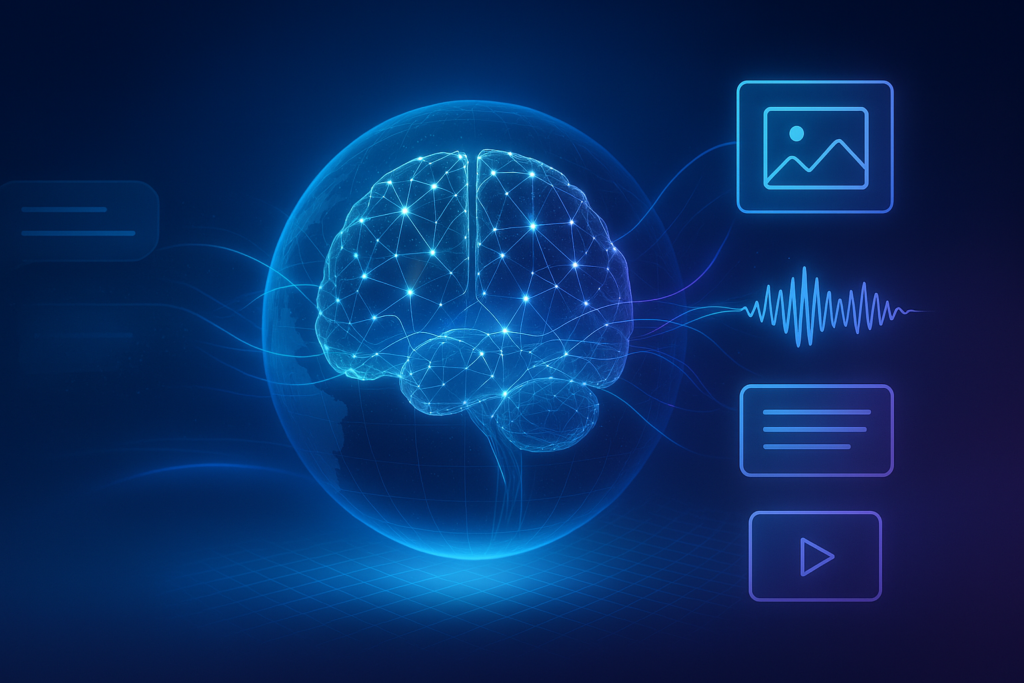
Part 1: The Senses (Multimodal AI)
Let’s start with the senses. Human intelligence isn’t just about reading books. We learn by seeing, hearing, touching, and smelling. We are “multimodal.”
What is Multimodal AI?
Simply put, Multimodal AI is artificial intelligence that can process and understand different types of data (modes) simultaneously.
- Text: What we read and write.
- Vision: Images and videos.
- Audio: Speech, music, and environmental sounds.
How It Works (The Simple Version)
Think of it like this: In the past, you had a “Text Expert” and an “Image Expert” living in different rooms. If you wanted to analyze a picture of a cat, you could only ask the Image Expert, who might say, “It’s a feline.” But you couldn’t ask why the cat looked sad, because the text expert wasn’t in the room.
Modern Multimodal AI acts like a conference room where all the experts sit together. They share their information. The vision part sees the cat’s droopy eyes and flat ears, translates that into data, and passes it to the language part, which then says, “The cat looks sad because its ears are back and its eyes are squinting.”
Real-World Examples You Might Have Seen:
- Google Lens: Point your phone at a plant, and it tells you what it is.
- OpenAI’s GPT-4 with Vision: You can upload a screenshot of a buggy app, and it will read the error message (text) and see the layout (vision) to tell you how to fix it.
- Meta’s Ray-Ban Stories: Glasses that can see what you see and give you context-aware information.
Part 2: The Brain (World Models)
Sensing the world is one thing. Understanding how the world works is another. This is where World Models come in. This concept is a bit more abstract, but it is the secret sauce for true intelligence.
What is a World Model?
A World Model is an internal representation of the environment inside an AI’s “mind.” It’s a simulator. It allows the AI to predict the consequences of its actions without actually doing them in the real world.
The Analogy: The Driver vs. The Simulator
Imagine learning to drive.
- Standard AI: You learn by crashing a thousand times. You turn the wheel left, you hit a curb. You learn that “left + too much = curb.” This is expensive and slow (Reinforcement Learning).
- AI with a World Model: Before you even touch a real car, you play a video game simulator. In your head (or in the code), you have a model of how cars behave. You predict, “If I turn left here, I will end up in the other lane.” You learn safely and efficiently.
A World Model is that internal simulator. It learns the “physics” and “rules” of its environment.
Why Are World Models a Big Deal?
- Planning: If you want a robot to pour a glass of water, it needs to predict what happens if it tilts the bottle 10 degrees vs. 40 degrees. The World Model runs that test internally first.
- Efficiency: They require less real-world data. The AI can “dream” or imagine scenarios to learn from, rather than needing millions of real-life examples.
- Causality: They help AI understand cause and effect. It’s not just that a billiard ball moved; it’s that I hit it with the cue stick, so it moved.
Part 3: The Fusion (Multimodal World Models)
Here is where it gets exciting. We are now fusing the Senses (Multimodal) with the Brain (World Models).
We are teaching AI to build a simulator of reality based on what it sees and hears.
How does this fusion happen?
Let’s say you show an AI thousands of hours of video of people playing basketball.
- Multimodal Input: The AI watches the video (vision) and listens to the commentary and the bounce of the ball (audio).
- Learning Physics: It notices that when the player jumps, they always come down. It sees that the ball doesn’t float in the air.
- Learning Intent: It sees that when a player looks at the hoop and raises the ball, the next frame usually shows a throw.
Over time, the AI builds a World Model of Basketball. If you give it a starting image of a player about to shoot, the World Model can predict the next 5 seconds of video with surprising accuracy because it “understands” the physics and flow of the game.
Why This Combination is So Powerful
By combining these two fields, we move from “pattern matching” to “understanding.” Here’s why:
- Grounded Intelligence: When you only train on text, the AI doesn’t know what “wet” feels like. But if you train on video of rain, puddles, and people shaking umbrellas, the concept of “wet” becomes grounded in visual reality. The AI understands the context.
- Actionable Knowledge: A text-only AI can write a recipe for an omelet. A Multimodal World Model can watch you crack an egg, see that you left shell in the bowl, and say, “Wait, you need to fish that out, or the texture will be off.”
Part 4: Real-World Use Cases
This isn’t just academic research. This technology is on the verge of reshaping entire industries.
1. Robotics and Automation
The holy grail of robotics is the “general-purpose robot” that can enter your home and do dishes.
- Old Way: Program every single movement. If the dish is a different shape, the robot fails.
- New Way: The robot uses a World Model. It has watched videos of humans washing dishes. It understands that “wet” things are slippery, that “heavy” things need two hands, and that “soap” makes bubbles. It can adapt to your specific kitchen sink in real-time because it has a mental model of the world to guide it.
2. Autonomous Vehicles
Self-driving cars are getting better, but edge cases (like a mattress falling off a truck) are scary.
- Multimodal Sensors: Cameras, LiDAR, and Radar feed data into the car’s “brain.”
- World Model: The car doesn’t just detect the mattress; its World Model predicts the trajectory. “That mattress is falling; it might bounce; the car behind me will likely swerve.” It plans its reaction based on predicted outcomes, not just current inputs.
3. Immersive Content Creation (AR/VR and Hollywood)
Imagine telling your VR headset, “Create a medieval castle on a hill during a thunderstorm.”
- World Model: It knows castles are heavy, so they sit on solid ground. It knows rain falls down, not up. It knows lightning comes from clouds.
- Multimodal Generation: It renders the visuals, adds the sound of rain (audio), and ensures the physics of flags blowing in the wind (motion) is correct. You aren’t just seeing a picture; you are entering a consistent, believable world.
4. Scientific Discovery
- Protein Folding: Models like AlphaFold are essentially World Models of biology. They predict how proteins will fold based on their chemical structure, simulating a biological process to save years of lab work.
- Climate Modeling: More advanced World Models can simulate the interaction between atmosphere, ocean, and land to predict climate change with higher accuracy.
The Road Ahead
We are moving from AI that reads the internet to AI that understands the universe.
- Today: We have chatbots and image generators. They are impressive, but they often get basic physics wrong (like generating a hand with six fingers).
- Tomorrow: We will have agents that can navigate your home, digital twins that simulate your factory, and creative tools that build entire worlds from a sentence.
The journey “Beyond Chat” is about giving AI the tools to perceive reality and simulate consequences. It’s about building minds that don’t just predict the next word, but predict the next moment.
It’s a wild time to be watching this space. The future isn’t just about talking to your computer; it’s about your computer understanding the world you live in.
What are your thoughts on AI developing a “simulation” of reality? Is it exciting or a little scary? Let me know in the comments below!