
- 3D Render Prompts
- AI Art Prompts
- Artificial Intelligence
- Cinematic Prompts
- Cyberpunk Prompts
- Hyper Realistic Prompts
- Programming
- Prompt Hub
- Realistic Photo Prompts
- Wallpaper Prompts
We’ve been spoiled. For the last two years, we’ve watched AI generate poems, write code, and answer trivia questions in the blink of an eye. But here is the hard truth: most of the AI we interact with today is blind and detached from reality.
When you ask ChatGPT to plan a road trip, it gives you a list of stops. It doesn’t “see” the winding mountain roads or “understand” that rain might make a particular route dangerous. It is manipulating text, not reasoning about the world.
We are standing at the edge of a massive shift. The future of artificial intelligence isn’t just about better chat. It is about World Models and Multimodal AI.
Here is why this matters, and why it will change everything about how you interact with technology.
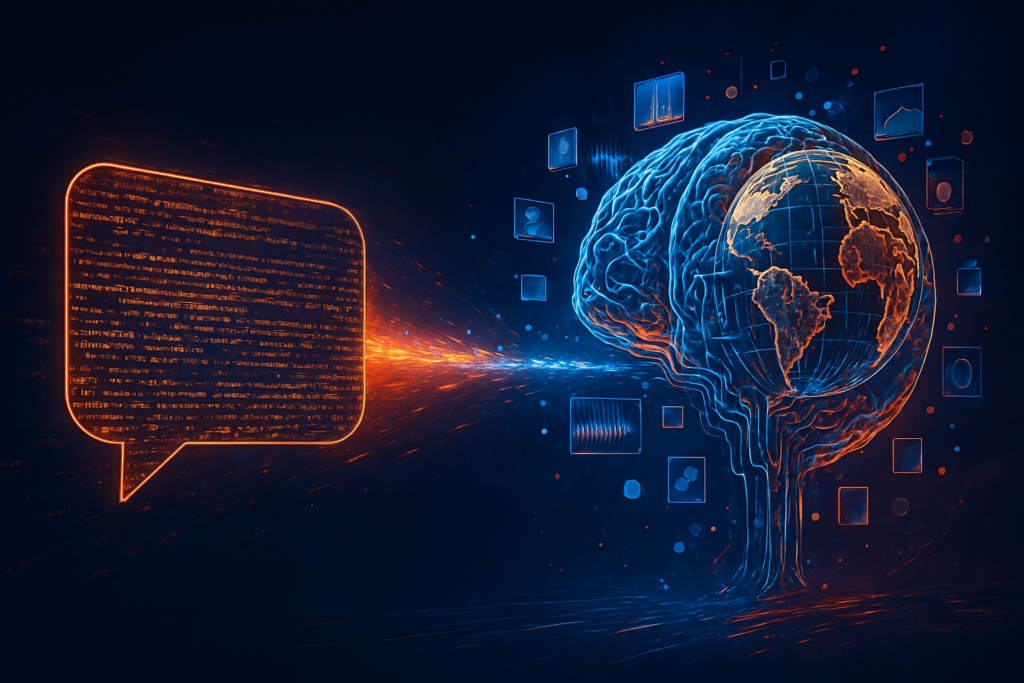
The Problem with “Text-Only” Brains
To understand the leap, we have to look at the limitation of Large Language Models (LLMs) like the ones behind standard chatbots. They are statistical prediction machines. They guess the next word based on the data they were trained on.
They lack mental simulation.
If you describe a glass falling off a table, a text-based AI knows the words “glass,” “fall,” and “break.” But it doesn’t truly grasp the physics of gravity, the fragility of glass, or the sound of the shatter because it has never “seen” it happen. It is reading a cookbook about food without ever tasting a single ingredient.
What is Multimodal AI? (Learning with Eyes and Ears)
Multimodal AI is the first step toward fixing this blindness. Instead of just reading text, these models are trained on a mixture of data:
- Text
- Images
- Audio
- Video
Think of it like this:
- Unimodal AI: Reads a recipe for chocolate cake.
- Multimodal AI: Reads the recipe, looks at a photo of the finished cake, and watches a video of the chef folding the batter to see the correct texture.
Why this is a game changer:
With multimodal AI, you aren’t just typing your query. You can show the AI what you mean.
- In Healthcare: A doctor could upload an X-ray (Image) and the patient’s symptoms (Text) to get a more accurate diagnosis.
- In Shopping: You could take a photo of your living room, snap a picture of a lamp you like, and ask the AI, “Will this lamp match my couch?” The AI sees both images.
- In Education: A student can take a picture of a complex chemical diagram and ask, “Explain this reaction to me.”
Multimodal allows the AI to perceive the world the way we do—through a blend of senses.
The Secret Sauce: World Models
This is where it gets truly exciting. If Multimodal AI gives AI “senses,” World Models give AI a “imagination” and “intuition.”
A World Model is an AI that builds an internal understanding of how the world works. It doesn’t just recognize objects; it understands the cause and effect between them.
Coined heavily in the research of people like Yann LeCun (Meta’s Chief AI Scientist), a world model allows an AI to simulate the future. It answers the question: “If I do this, what happens next?”
Think of it like a flight simulator for the mind.
- When you play chess, you simulate the board a few moves ahead. That is a world model.
- When you catch a ball, your brain subconsciously calculates its trajectory. That is a world model.
Real-World Impact of World Models:
- Robotics: Currently, robots are clumsy because they can’t predict the real world. With a world model, a robot asked to pour water into a glass would simulate the action first. It would predict the water level rising and know to stop before the glass overflows.
- Autonomous Vehicles: A car doesn’t just need to identify a pedestrian (Multimodal). It needs to predict that the pedestrian might step off the curb to cross the street (World Model).
- Scientific Discovery: An AI with a world model could simulate protein folding or climate patterns at a speed and accuracy humans cannot match, predicting outcomes years in advance.
Why This Combo is Unstoppable
When you combine Multimodal perception with World Model reasoning, you get an AI that doesn’t just parrot information—it understands context.
The Chatbot 2.0 Experience:
Imagine you are renovating your kitchen. You point your phone camera at the current space. You speak into the mic:
“I want to move this sink under the window.”
The Multimodal AI sees the plumbing against the wall, the location of the window, and the size of the cabinets.
The World Model simulates the renovation. It realizes the plumbing pipes need to extend three feet, which might interfere with a drawer below. It then projects an overlay onto your screen showing the potential conflict and offers a solution.
We have moved from answering questions to solving physical problems.
The SEO and Content Revolution (For the Creators)
As an SEO manager, you might wonder, “How does this affect my website?”
The answer is huge. Search is becoming visual and conversational.
Traditional Search: User types “how to fix a leaking faucet.”
Future Search: User shows a video of their specific faucet leaking to a Multimodal AI agent.
How to prepare your content:
- Embrace Visual Context: Don’t just write text. Create diagrams, infographics, and video walkthroughs. The AI of the future will need to index this visual data to understand your content.
- Focus on Entities, Not Just Keywords: World Models care about the relationship between things. Write about topics comprehensively. Connect the concepts. Show how “plumbing” relates to “water pressure” relates to “pipe material.”
- Optimize for Action: People will start asking AI to do things. Create content that answers “how-to” questions with precise, logical steps that a World Model could simulate.
The Bottom Line
We are entering the Simulation Era of AI.
The days of typing into a box and getting a block of text back are numbered. We are moving toward a future where AI sees what we see, hears what we hear, and most importantly, intuitively understands the physics and logic of the world around us.
It won’t be long before your AI assistant doesn’t just tell you the weather forecast—it will look at your outfit, look at the dark clouds outside, and simply say, “Better grab an umbrella.”
The future isn’t just chat. It’s understanding. And it is arriving faster than we think.