
- 3D Render Prompts
- AI Art Prompts
- Artificial Intelligence
- Cinematic Prompts
- Cyberpunk Prompts
- Hyper Realistic Prompts
- Programming
- Prompt Hub
- Realistic Photo Prompts
- Wallpaper Prompts
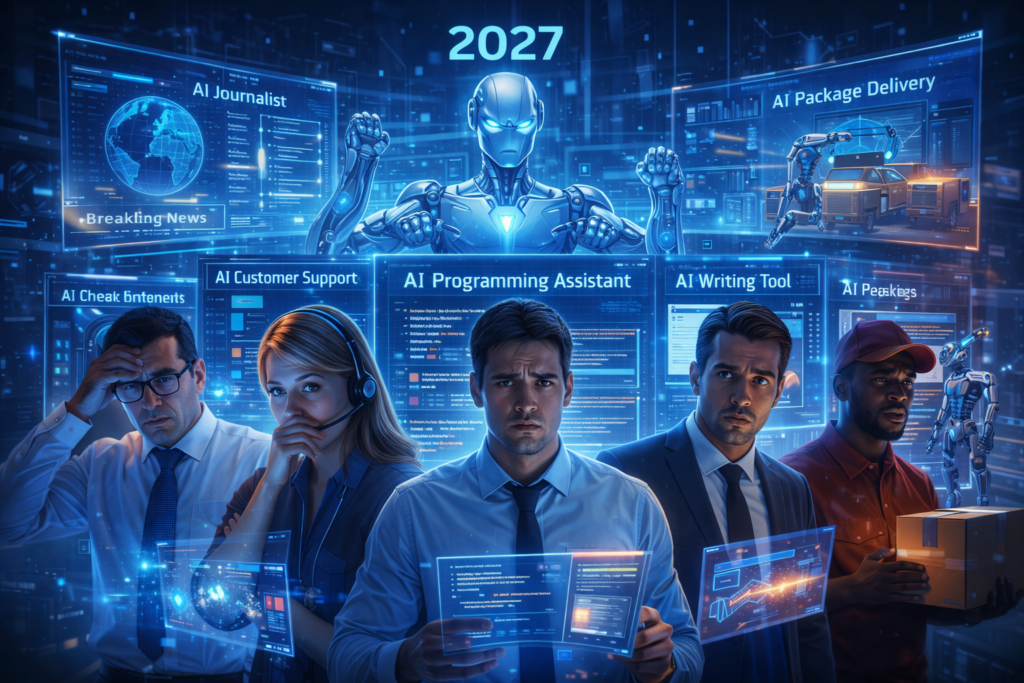
The timeline for AI-driven workplace transformation has accelerated dramatically. What was once a distant concern is now knocking at the door—and for some professions, 2026 and 2027 could mark a turning point.
Recent warnings from leading AI researchers and economic analysts paint a sobering picture. Dr Roman Yampolskiy, a computer scientist at the University of Louisville, suggests that Artificial General Intelligence capable of outperforming humans across most cognitive tasks could arrive as early as 2027, potentially rendering up to 99% of jobs obsolete . While that figure represents a worst-case scenario, more conservative estimates still point to significant disruption.
According to Oxford Economics, roughly 20% of US jobs face high automation risk over the next decade, with transportation and logistics leading the pack at 60% exposure . The World Economic Forum’s Future of Jobs report identifies multiple roles facing decline between now and 2027, driven primarily by technology adoption and digitalisation .
Mustafa Suleyman, Microsoft’s AI chief, delivered an even more urgent warning: most white-collar tasks performed by lawyers, accountants, and marketers could be fully automated within just 12 to 18 months .
For workers in vulnerable fields, this isn’t a distant future—it’s arriving now. Here are five job categories facing the highest risk in 2026-27, why they’re vulnerable, and what could replace them.
1. Administrative and Clerical Support
Administrative roles have long been the backbone of office operations, but they’re also the most straightforward to automate. The World Economic Forum explicitly lists secretaries, bank tellers, payroll clerks, and data entry clerks among the fastest-declining roles .
Why 2026-27 is critical: Generative AI can now draft emails, summarize documents, schedule meetings, and manage calendars with minimal human oversight. Combined with agentic AI—systems that can execute multi-step workflows independently—the need for human administrative support diminishes rapidly.
Microsoft’s analysis of workplace interactions found that jobs involving language processing and data management have the highest overlap with current AI capabilities . For administrative professionals, the message is clear: routine tasks will increasingly be handled by software.
2. Customer Service and Sales
Customer service has already seen significant automation, but the next wave will be transformative. Gartner predicts that by 2028, companies using multiagent AI for at least 80% of customer-facing processes will gain significant competitive advantage .
Why 2026-27 is critical: Modern AI agents don’t just answer simple questions—they can handle complex troubleshooting, process returns, upsell products, and even detect customer sentiment. Oxford Economics notes that accommodation and catering face 47.2% automation exposure, with retail at 40.2% .
The economics are irresistible for businesses: AI doesn’t require sleep, doesn’t experience burnout, and scales instantly during peak demand. For customer service workers, the transition is already underway.
3. Content Creation and Translation
Creative roles were once considered safe from automation—after all, machines can’t be creative, right? That assumption is crumbling. Dr Yampolskiy argues that even media production and content creation will be automated because machines work faster, with greater accuracy and access to vast amounts of data .
Why 2026-27 is critical: Current AI models can write blog posts, draft marketing copy, translate between dozens of languages, and even generate video scripts. The NASSCOM-Indeed report notes that 20-40% of work across technology organisations is already AI-driven, with 45% of respondents reporting that over 40% of software development is done by AI .
For translators, the threat is particularly acute. Neural machine translation has improved dramatically, handling nuance and context far better than earlier systems. While human oversight remains valuable for high-stakes content, routine translation work is rapidly disappearing.
4. Transportation and Logistics
Transportation and logistics face the highest exposure of any sector. Oxford Economics evaluated more than 800 occupations and found that roughly 60% of transportation and logistics jobs could be automated as self-driving systems and warehouse robotics continue to scale .
Why 2026-27 is critical: The technology required for automation already exists and is scaling rapidly. Autonomous vehicle testing has accumulated millions of miles, and warehouse automation is already widespread in major fulfilment centres. Manufacturing faces 51.1% vulnerability, while wholesale sits at 31.0% .
Nico Palesch, senior economist at Oxford Economics, warns that displacement could be particularly difficult for older workers: “A 50-year-old truck driver whose livelihood is eliminated by autonomous vehicle software is unlikely to find equally skilled, equally paid work elsewhere” .
5. Data Analysis and Processing
The World Economic Forum explicitly identifies accountants, bookkeepers, and payroll clerks among roles facing significant decline . According to Draup’s report cited by CIO Dive, by 2027, more than 40% of IT skills will be rendered partially obsolete .
Why 2026-27 is critical: Data analysis was one of the first fields where AI demonstrated clear superiority. Modern systems can process millions of data points, identify patterns, and generate reports in seconds—tasks that might take a human analyst days or weeks.
Mustafa Suleyman specifically called out accountants as being at immediate risk, stating that most of their current tasks will be fully automated within 12-18 months . The NASSCOM-Indeed report reinforces this, noting that routine and repeatable tasks, including boilerplate code generation and unit test creation, are expected to be increasingly automated over the next two to three years .
What This Means for Workers
High risk doesn’t automatically mean immediate unemployment—at least not for everyone. J.P. Gownder, VP and principal analyst at Forrester, offers a nuanced perspective: “AI will take over increasing numbers of workflows and tasks, but workflows and tasks aren’t jobs. Your strategy must invest in the people who use AI to improve their productivity” .
However, this requires adaptation. The NASSCOM-Indeed report emphasizes that success depends on how effectively workers augment their capabilities with AI rather than competing against it .
Skills that will remain valuable:
- Critical thinking and independent reasoning (Gartner predicts 50% of organizations will require AI-free skills assessments by 2026)
- Emotional intelligence and human connection (therapy, counselling, relationship-based professions)
- AI oversight and regulation
- Multidisciplinary skills combining technical knowledge with domain expertise
Dr Yampolskiy suggests that while most jobs may vanish, a small number of roles could persist: personal services for the wealthy, emotion-centred roles, AI oversight specialists, AI intermediaries who help organizations adopt the technology, and prompt engineers . But he warns these will support only a tiny fraction of today’s workforce.
Final Thoughts
The 2026-27 timeline represents a critical juncture. Whether AI eliminates 20% of jobs or 99%, the direction is clear: routine cognitive and physical work will increasingly be handled by machines. The window for adaptation is closing, and the workers who thrive will be those who embrace AI as a tool rather than viewing it as a threat.
For those in the five high-risk fields identified above, the time to start transitioning—whether through upskilling, reskilling, or reimagining your role—is now.
*This article draws on research from the World Economic Forum, Oxford Economics, McKinsey, Microsoft, NASSCOM-Indeed, Gartner, and leading AI experts to provide a comprehensive view of employment risks through 2027.*